Quick links


Quick links
Quick links
Quick links
Quick links
Quick links
King Edward Parade, Devonport, AUCKLAND
Public
Historic Place Category 2
List No. 4517


List Entry Information
Status
Listed
List Entry Status
Historic Place Category 2
Access
Able to Visit
List Number
4517
Date Entered
30th June 2006
Date of Effect
30th June 2006
City/District Council
Auckland Council
Region
Auckland Council
Extent of List Entry
Extent of proposed registration includes part of the land in SO 20236 North Auckland and bed of Waitemata Harbour (as shown on Map B of Appendix 4 of the Registration Report), and the memorial, its fittings and fixtures thereon. Fixtures and fittings include a clock and commemorative plaque. The registration incorporates a small semi-circular area of lawned ground around the memorial. The ground may incorporate the archaeological remains of a nineteenth-century jetty.
Legal description
Part of SO 20236 North Auckland, and part bed of Waitemata Harbour
Location Description
R31, King Edward Parade, Devonport, Auckland
Why is this place significant?
Cultural Significance
The memorial has social significance as a public clock, used and maintained for 70 years.
Historic Significance
Historical Significance or Value The structure has historical value for its associations with the development and beautification of the Devonport esplanade, and with Devonport-born philanthropist A.R.D. Watson, whose bequest enabled works on King Edward Parade to be carried out. It also has historical value as one of five early twentieth-century clocks erected at strategic locations in the Borough, when public transport run according to 'time and tide' formed the main means of travel in Devonport.
Physical Significance
The Watson Memorial has aesthetic significance for its simple art deco design and harbourfront location, and as a focal point at the end of Church Street.
Why is this place Category 1 / Category 2?
Detail Of Assessed Criteria
(a) The extent to which the place reflects important or representative aspects of New Zealand history The Watson Memorial reflects important and representative aspects of New Zealand history, including public benefaction in the early 1900s, the beautification of seaside towns and suburbs, and the importance of timekeeping in an era of public transport. (b) The association of the place with events, persons, or ideas of importance in New Zealand history The Watson Memorial was unveiled as part of Devonport Borough's golden jubilee celebrations in November 1936, and is associated with Devonport-born A.R.D. Watson, who made numerous public bequests in Auckland, including funding for much of the sea wall along Devonport's King Edward Parade; the casting of a bronze sculpture - located in the Auckland Domain - to commemorate the centenary of Auckland city in 1940; and the establishment of a Gothic art collection at Auckland Art Gallery in 1965. (e) The community association with, or public esteem for, the place As one of five clocks erected at strategic locations throughout the former Devonport Borough; and as one of two memorial clocks erected on Devonport's iconic waterfront, the Watson Memorial has provided a useful service to the Devonport community for the past 70 years. During this period it has been maintained by the local council, indicating public esteem. (h) The symbolic or commemorative value of the place The Watson Memorial has commemorative value, marking the beneficence of A.R.D. Watson to the development and enhancement of Devonport's esplanade. (k) The extent to which the place forms part of a wider historical and cultural complex or historical and cultural landscape The Watson Memorial is part of a broader historical and cultural landscape along the Devonport waterfront, which incorporates the King Edward Parade sea wall, late Victorian/Edwardian premises at the junction of King Edward Parade and Church Street, mature pohutukawa trees and several memorials along King Edward Parade, including a monument commemorating the fourteenth-century landfall of the Tainui canoe. The landscape may also incorporate the archaeological remains of the nineteenth-century Devonport or Duder's Wharf and other commercial and industrial activity of a similar date along the foreshore. The Memorial is one of a network of early twentieth-century clocks in and around Devonport. Devonport, itself, is a particularly well-preserved nineteenth- and early twentieth-century suburb of metropolitan Auckland.
Construction Professional
Name
Griffiths, Arthur. T
Type
Engineer
Biography
Arthur T. Griffiths Arthur Griffiths (1896-1980) served as Devonport Borough Engineer from 1922 until his retirement in November 1967. During this period he oversaw the construction of Devonport's concrete roads, designed and built the Borough's drainage system and was the waterworks engineer responsible for North Shore's water supply from Lake Pupuke. Born in Auckland in 1896, Griffiths was educated at Auckland Grammar School and the University of Auckland. He was articled to the civil engineering firm of Gannon and MacDuff. After serving in the signal corps during the First World War (1914-1918), Griffiths became assistant engineer at Hamilton Borough and was responsible for its drainage system. In addition to his duties as Borough Engineer at Devonport, Griffiths was engineer to the Rangitoto Domain Board until his retirement, and in the 1920s and early 1930s built all roads and tracks on Rangitoto Island using prison labour. Griffiths served as Chairman of the Municipal Engineer's Works' Guild for a number of years and also was the primary officer reporting to Devonport's first town planning committee, convened in the late 1950s. In addition to grander projects such as the filtration plant for the North Shore water supply - designed with tanks 33.3 yards long enabling their later use as the Takapuna municipal swimming pool - Griffiths' role as Borough engineer also led to him designing local memorials, including the Watson Memorial (1936) on the waterfront and the current band rotunda adjoining Flagstaff Road in Windsor Reserve. In designing the latter, Griffiths is quoted as saying that he sought to achieve something ornamental, but with a musical atmosphere. The metal railing of the band rotunda represents bars of music; the notes are the opening bars of 'God Save the Queen'. Griffiths was also commissioned by the Borough to make a movie of the Queen's visit to Devonport in 1954. The film was shown at the Victoria Theatre in June of that year and is held by North Shore City Council Archives.
Construction Details
Type
Modification
Description
Clock hands replaced
Start Year
1936
Type
Original Construction
Start Year
1953
Type
Modification
Description
New electric clock installed
Start Year
1968
Type
Modification
Description
New face and glass
Start Year
1980
Type
Modification
Description
Three slave units overhauled; Master clock and dry cell batteries replaced with a Plessey Chronogram unit with mains-fail, and a 24 volt Gel Cell battery and regulated battery charger;
Start Year
1980
Type
Modification
Description
Photo cell unit fitted to switch the internal illumination on during hours of darkness. Continuous 230 volt supply installed
Construction Materials
Concrete column, podium and pad
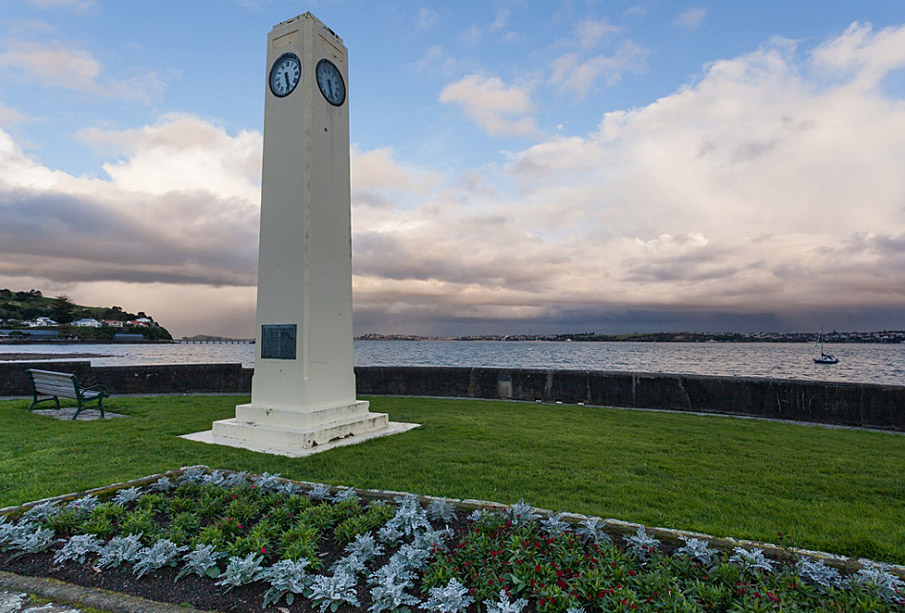
The Watson Memorial occupies a harbourside location in Devonport, a seaside suburb on the Waitemata Harbour opposite the main CBD of Auckland. The memorial lies on King Edward Parade, a lengthy esplanade extending to the east of Devonport's main ferry terminal. Together with a network comprising the Windsor Reserve and Queen's Parade, this esplanade helps to define the settlement's maritime character and is a particularly important feature when approaching Devonport from the sea. Devonport is noted for its well-preserved nineteenth- and early twentieth-century buildings. Located on the harbourward (south) side of King Edward Parade, the Watson Memorial is sited on a small horseshoe-shaped reclaimed area bounded by a rendered concrete sea wall. Below the sea wall on either side of the memorial are concrete terraces adjoining the beach, which provide seating for bathers. A historic rowing club building is located a short distance to the west of the memorial, while an esplanade reserve with mature pohutukawa trees is located off to the east. Buildings clustered around the Church Street intersection opposite the memorial include the Masonic Hotel and several late-Victorian/Edwardian-era commercial buildings. Constructed on the site of the former Devonport (also known as Duder's) Wharf, the reclamation material that provides the site for the Watson Memorial is likely to overlie archaeological deposits linked to Devonport's original cargo facility. Other archaeological material linked to boatbuilding and similar activities may lie nearby. The memorial stands in a small amenity area of lawn and flowerbeds - also incorporated within the registration - opposite a road junction with Church Street. The structure is a simple, streamlined monument that can be described as Art Deco in style. Standing on a stepped podium and a 2.8 m square concrete pad, the monument takes the form of a slightly tapering square plastered concrete column with chamfered corners. Apart from a band of short longitudinal saw-tooth lines let into the concrete close to the top edge, the structure is without decoration. The column, about 6m high, terminates in a shallow dome. Clock faces, illuminated at night, are located near the top of each elevation. Each surviving face is circular and inset behind glass. Incorporating Roman numerals, they are marked out with minutes, and have squat, curvaceous hands. Attached to the lower part of the elevation of the column, facing King Edward Parade, is a bronze plaque (730mm x 510mm) inscribed: Watson Memorial In Grateful remembrance of Alexander Richardson Dickey Watson Who was born at North Head Devon- port and Spent the Early Years of His Life in this District and Whose Gen- erous Bequest Enabled the Seawall along this Foreshore to be Erected March 1936 Currently painted in a cream colour, the memorial is particularly striking in its setting against the harbour and the green space of Bastion Point on the southern shore of the Waitemata Harbour. It provides an especially strong focal point when viewed from Church Street, although it is also a landmark as viewed from the harbour and elsewhere. It is one of several memorials located on or near the esplanade, including a plaque on the sea wall behind the Watson Memorial marking the site of the former Devonport Wharf, a memorial erected in 1959 to commemorate the arrival in the Waitemata Harbour of the Tainui canoe, and the Coronation Sea Wall marking the end of the South African - or Second Boer - War and the coronation of Edward VII. Another memorial clock, the Alison Clock, lies next to the main Devonport ferry terminal in Marine Square.
The Watson Memorial occupies a harbourside location in Devonport, a seaside suburb on the Waitemata Harbour opposite the main CBD of Auckland. The memorial lies on King Edward Parade, a lengthy esplanade extending to the east of Devonport's main ferry terminal. Together with a network comprising the Windsor Reserve and Queen's Parade, this esplanade helps to define the settlement's maritime character and is a particularly important feature when approaching Devonport from the sea. Devonport is noted for its well-preserved nineteenth- and early twentieth-century buildings. Located on the harbourward (south) side of King Edward Parade, the Watson Memorial is sited on a small horseshoe-shaped reclaimed area bounded by a rendered concrete sea wall. Below the sea wall on either side of the memorial are concrete terraces adjoining the beach, which provide seating for bathers. A historic rowing club building is located a short distance to the west of the memorial, while an esplanade reserve with mature pohutukawa trees is located off to the east. Buildings clustered around the Church Street intersection opposite the memorial include the Masonic Hotel and several late-Victorian/Edwardian-era commercial buildings. Constructed on the site of the former Devonport (also known as Duder's) Wharf, the reclamation material that provides the site for the Watson Memorial is likely to overlie archaeological deposits linked to Devonport's original cargo facility. Other archaeological material linked to boatbuilding and similar activities may lie nearby. The memorial stands in a small amenity area of lawn and flowerbeds - also incorporated within the registration - opposite a road junction with Church Street. The structure is a simple, streamlined monument that can be described as Art Deco in style. Standing on a stepped podium and a 2.8 m square concrete pad, the monument takes the form of a slightly tapering square plastered concrete column with chamfered corners. Apart from a band of short longitudinal saw-tooth lines let into the concrete close to the top edge, the structure is without decoration. The column, about 6m high, terminates in a shallow dome. Clock faces, illuminated at night, are located near the top of each elevation. Each surviving face is circular and inset behind glass. Incorporating Roman numerals, they are marked out with minutes, and have squat, curvaceous hands. Attached to the lower part of the elevation of the column, facing King Edward Parade, is a bronze plaque (730mm x 510mm) inscribed: Watson Memorial In Grateful remembrance of Alexander Richardson Dickey Watson Who was born at North Head Devon- port and Spent the Early Years of His Life in this District and Whose Gen- erous Bequest Enabled the Seawall along this Foreshore to be Erected March 1936 Currently painted in a cream colour, the memorial is particularly striking in its setting against the harbour and the green space of Bastion Point on the southern shore of the Waitemata Harbour. It provides an especially strong focal point when viewed from Church Street, although it is also a landmark as viewed from the harbour and elsewhere. It is one of several memorials located on or near the esplanade, including a plaque on the sea wall behind the Watson Memorial marking the site of the former Devonport Wharf, a memorial erected in 1959 to commemorate the arrival in the Waitemata Harbour of the Tainui canoe, and the Coronation Sea Wall marking the end of the South African - or Second Boer - War and the coronation of Edward VII. Another memorial clock, the Alison Clock, lies next to the main Devonport ferry terminal in Marine Square.
Historical and Associated Iwi / Hapū / Whānau
Information Sources
Auckland Star
Auckland Star
Musgrove, 1986
Sydney Musgrove (ed), The Hundred of Devonport: A Centennial History, Devonport, 1986.
New Zealand Herald
New Zealand Herald, 12 July 1932, p. 6; 28 September 1933, p. 6.
North Shore City Council
North Shore City Council
North Shore Times Advertiser
North Shore Times Advertiser
Other Information
A fully referenced registration report is available from the NZHPT Northern Region Office Please note that entry on the New Zealand Heritage List/Rarangi Korero identifies only the heritage values of the property concerned, and should not be construed as advice on the state of the property, or as a comment of its soundness or safety, including in regard to earthquake risk, safety in the event of fire, or insanitary conditions.
Current Usages
Uses: Civic Facilities
Specific Usage: Clocktower/ clock
Uses: Commemoration
Specific Usage: Memorial - Particular person or group
Former Usages
General Usage: Civic Facilities
Specific Usage: Clocktower/ clock
General Usage: Commemoration
Specific Usage: Memorial - Particular person or group
Location
Get the latest heritage news, features and events delivered
straight to your inbox.